Introduction
WooCommerce includes a built-in product search, but anyone running a real store knows its limits.
As catalogs grow and products become more complex, keyword-based search starts to break down. Customers don’t search like databases — they search like humans.
They describe problems, needs, and use cases. Traditional WooCommerce search is not designed to understand that.
This is why product discovery becomes one of the biggest hidden bottlenecks in WooCommerce stores.
How WooCommerce Keyword Search Works Today
Default WooCommerce search relies on exact or partial keyword matching.
It typically searches within:
- Product titles
- Short and long descriptions
- Sometimes SKUs or attributes
If a product does not contain the exact words used by the customer, it simply won’t appear — even if it is the best match.
This system works only when:
- Customers know product names
- Categories are obvious
- Keywords match descriptions perfectly
In real-world stores, this is rarely the case.
Common Search Problems in WooCommerce Stores
1. Customers Search by Intent, Not Keywords
Shoppers don’t think in attributes or taxonomies.
They search like this:
- “Something for sensitive skin”
- “Shoes I can walk all day in”
- “A cheaper alternative to this product”
Keyword search cannot interpret intent — it only matches words.
2. Variants and Attributes Are Hard to Discover
Products with multiple:
- Sizes
- Colors
- Materials
- Technical specs
are often invisible unless users know the exact terms.
Semantic meaning between variants is completely lost in keyword-based systems.
3. Empty or Irrelevant Search Results
When search results are:
- Empty
- Poorly ordered
- Irrelevant
customers assume the product does not exist — and leave.
This happens even when the store actually has the right product.
Why Keyword Search Fails at Scale
As product catalogs grow, keyword search becomes fragile:
- More products = more overlapping terms
- More attributes = more ambiguity
- More content = more noise
Without understanding context, search accuracy drops quickly.
How AI Fixes Product Search in WooCommerce
AI-powered search does not rely on keywords alone.
The WooCommerce AI Sales & Support Assistant uses semantic search, which focuses on meaning rather than words.
How Semantic Search Works
1. Products Are Indexed by Meaning
The plugin converts:
- Products
- Categories
- Attributes
- Pages
- FAQs
- Uploaded files (PDF, JSON, DOCX, CSV)
into semantic vectors stored in a vector database.
This allows the system to understand:
- What a product is for
- How it is used
- How it relates to other products
2. Queries Are Interpreted in Context
Instead of matching words, the AI analyzes:
- User intent
- Natural language
- Current page (product, category, cart)
- Previous messages in the session
This makes vague or imprecise searches usable.
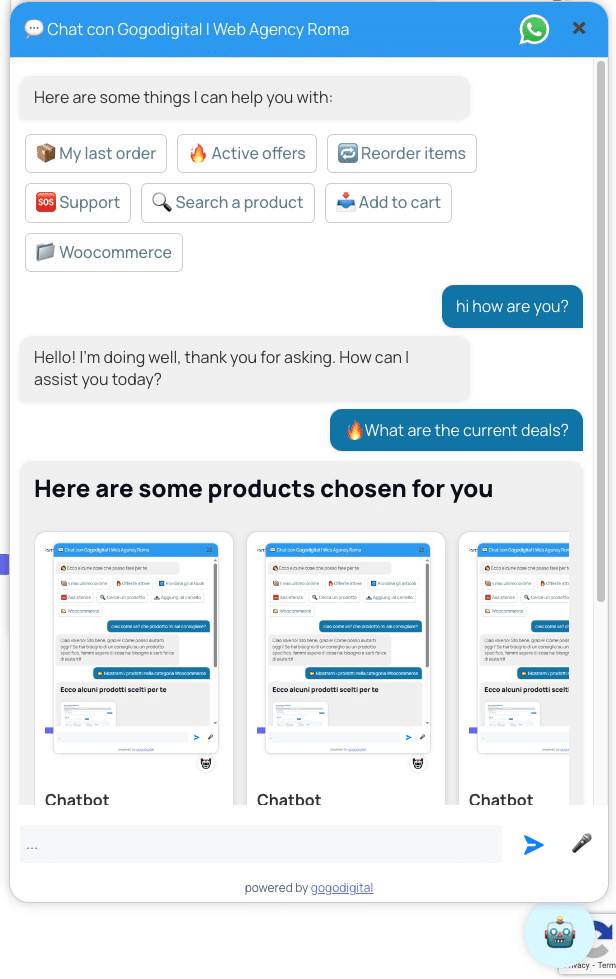
3. Results Are Delivered Conversationally
Search results are not a static list.
The chatbot responds with:
- Relevant products
- Visual product carousels
- Prices and variants
- Direct “Add to cart” actions
All inside a conversational interface.
Keyword Search vs Semantic Search
| Keyword Search | Semantic Search |
|---|---|
| Matches exact words | Understands meaning |
| Breaks on vague queries | Handles natural language |
| Ignores context | Uses page, cart and session context |
| Static result lists | Conversational, interactive results |
| Poor with variants | Understands attributes and relations |
Why a Chatbot Is the Right Interface for Search
Semantic search works best when users can ask, not type keywords.
A chatbot allows customers to:
- Refine requests naturally
- Ask follow-up questions
- Compare alternatives
- Act immediately
The search experience becomes part of the buying journey — not a separate step.
From Search to Action
Because the assistant is fully integrated with WooCommerce, search results connect directly to actions:
- Add products to cart
- Suggest variants or upgrades
- Recommend related items
- Reorder past purchases
- Retrieve order information
No extra clicks, no new pages.
Conclusion
Keyword search was never designed for modern e-commerce behavior.
As WooCommerce stores grow, relying on exact keywords limits product discovery and creates friction.
AI-powered semantic search fixes this by understanding intent, context, and meaning.
The WooCommerce AI Sales & Support Assistant turns product search into a conversation — and conversations into actions.
